- The Daily GOOD
- Posts
- 11 old-school parenting rules making a comeback
11 old-school parenting rules making a comeback
Chores, bedtimes, Wicked, a world-first burn treatment and the pacemaker that lasted three hours.

Greg Sullivan
October 08, 2026 • Est. Reading Time: 4 minutes


“Some people without brains do an awful lot of talking, don't you think?”
― Frank Baum
Chores. Bedtimes. Manners. Limited screen time. Somewhere, a boomer parent is reading this and quietly feeling vindicated. Neha B. has 11 old-school parenting rules making their way back into the conversation. Then Annie Reneau traces Wicked back to one tiny line in The Wizard of Oz, Erik Barnes looks at a remarkable new burn treatment, and we revisit the first implantable pacemaker, which failed almost immediately and still helped change the world.
Ideas

Maybe Mom and Dad had a few things figured out after all.
Every generation eventually gets its turn in the parenting hot seat. Boomers have certainly taken their share of heat, but teacher and mom Teresa Kaye Newman thinks we may have thrown out a few perfectly good rules along with the wood paneling and ashtrays.
After more than 13 years working with hundreds of kids, Newman put together 11 things she believes boomer parents genuinely got right. As Neha B. reports, her list ranges from screen-time boundaries and chores to manners, bedtimes, and the once-sacred art of not interrupting two adults while they're talking.
Not every rule will survive a modern-parenting group chat unscathed. But taken together, they make a surprisingly convincing case for bringing a little old-school structure back into childhood, without necessarily bringing back everything else that came with it.


GOOD reader Eileen Adickes caught this beautiful sunrise over Macedonia, Iowa, where the town’s old-fashioned water tower made for a killer silhouette against that soft pink sky. Great composition, great color, great timing.
Do you have a GOOD picture to share?
Send us your best images, and we may feature them as the image of the day. Be sure to tell us a bit about your pic.

Which old-school parenting rule deserves the biggest comeback?Grandma may have had a point. |
Yesterday's Results
In yesterday's issue, we looked back at humanity's first glimpse of the far side of the Moon.
And we asked: Over time, about how much of the Moon's surface can actually be seen from Earth? 36.4% of you knew the answer was 59%. A little lunar libration lets us peek around the edges.
48% (23.4%)
59% (36.4%) 🏆
67% (23.4%)
75% (16.9%)
Pop Culture | Courtesy of Upworthy
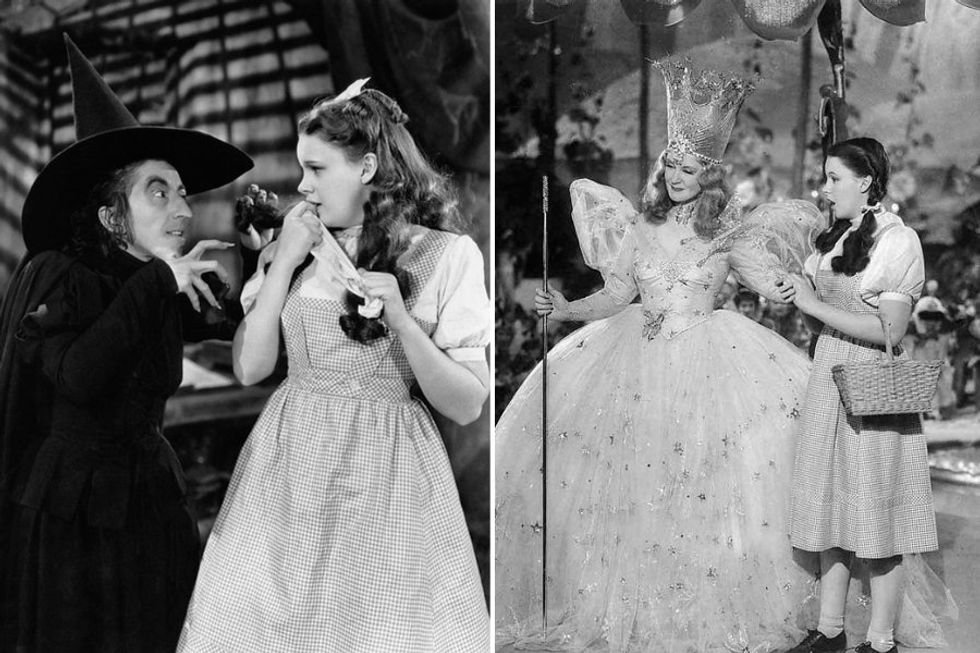 | ||
The two witches in "The Wizard of Oz" clearly had a history together. | ||
‘Wicked’ author says one line in ‘The Wizard of Oz’ inspired Elphaba and Glinda’s backstory | ||
Gregory Maguire says he “fell down to the ground” laughing when the idea hit him. | ||
By Annie Reneau | ||
Have you ever watched a movie or read a book or listened to a piece of music and wondered, “How did they come up with that idea?” The creative process is so enigmatic even artists themselves don’t always know where their ideas come from, so it’s a treat when we get to hear the genesis of a brilliant idea straight from the horse’s mouth. It’s often not what you would expect! If you’ve watched “Wicked” and wondered where the idea for the friendship between Elphaba (the Wicked Witch) and Glinda (the Good Witch) came from, the author of the book has shared the precise moment it came to him. | ||
The hit movie “Wicked” is based on the 20-year-old hit stage musical, which is based on the novel “Wicked: The Life and Times of the Wicked Witch of the West” written by Gregory Maguire. While the musical is a simplified version of the 1995 book, the basic storyline, the origin story of the two witches from “The Wizard of Oz,” lies at the heart of both. In an interview with BBC, Maguire explained how Elphaba and Glinda’s friendship popped into his head. | ||
|
Care

One trillion of the body's own messengers, two treatments, and a result doctors called a miracle
Last December, 18-year-old Kaitlyn Jeffrey was at a Pi Kappa Alpha party at Western University in Ontario when rubbing alcohol hit an open flame. Within seconds, her face and hair were on fire. She was one of five rushed to the hospital, and when the smoke cleared, doctors faced a choice: the standard skin graft, or something that had never been done before on a living human being.
The burn unit at Hamilton Health Sciences decided to go for it. As Erik Barnes reports, they applied for emergency approval from Health Canada to treat Kaitlyn with exosomes, tiny biological packages present in nearly every cell in the human body that carry proteins and genetic signals from cell to cell. One trillion of them were injected directly into her burned tissue across two rounds of treatment. The lead surgeon's goal was explicit: "You can do the best graft on the planet, but you won't return the skin to normal." He wanted better than normal.
The results stunned everyone. Her facial tissue healed with significantly less scarring than a graft would have produced, and the inflammation the burns had triggered all but disappeared. It's the kind of outcome that opens doors, not just for burn victims, but potentially for patients dealing with neurological disorders, cardiovascular disease, and cancer, conditions researchers are now exploring exosomes to treat. Kaitlyn, for her part, isn't thinking about any of that yet. "It's honestly a miracle," she said. "Having such good results, particularly to my face, is helping me move forward."


On October 8, 1958, Swedish surgeon Åke Senning implanted the world’s first fully implantable pacemaker into 43-year-old engineer Arne Larsson. Larsson’s heart condition had become so severe that he was suffering repeated attacks and sometimes needed to be resuscitated multiple times a day.
The device, designed by physician and engineer Rune Elmqvist, was hardly an instant technological triumph. It stopped working after about three hours. A replacement implanted the next morning lasted only a couple of days. But the idea worked. Pacemakers improved, Larsson received more than 20 replacements over the years, and he lived until age 86, eventually outliving both Senning and Elmqvist. The first pacemaker lasted three hours. Its first patient lived another 43 years.
Do you have something GOOD to share?
We’re always on the lookout for uplifting, enlightening, and engaging content to share with readers like you. If you have something you think should be featured in the Daily GOOD, let me know!
💬 From the group text…
I learned something while watching this stunning video of the world turning. I learned that there are free $7000 camera setups out there for the taking if you know where to look! (I’m kidding!)

Join the Group Text! Send us your social media gold.
Until tomorrow, let’s hope the pace of medicine keeps up. (ahem)