- The Daily GOOD
- Posts
- A world map, a hidden hand, and seven little phrases
A world map, a hidden hand, and seven little phrases
A familiar portrait pose, a questionable world map, and the words happy couples keep handy.

Greg Sullivan
October 22, 2026 • Est. Reading Time: 3 minutes


“A map says to you.
Read me carefully, follow me closely, doubt me not...
I am the earth in the palm of your hand.”
― Beryl Markham
Today’s issue comes with a small request: look again. At the world map you grew up with. At Napoleon’s oddly occupied hand. At the everyday conversations you have with the person you love. Jack Swab and Derek H. Alderman give us reason to reconsider the first, historians help with the second, and a psychologist has seven suggestions for the third. We’ll start with the entire planet and work our way home.
Science

It feels wrong, but it’s closer than what you’re used to.
That the map of the world has misled us our whole lives feels like a special kind of betrayal
A round planet has a flat-map problem.
Picture the world map from your classroom wall. Giant Greenland. Sprawling Russia. Africa somewhere in the middle, about the size of the rest of the continents. It’s a lie! It’s all a lie. Well, a distortion. That’s going to happen when you try to flatten the surface of a sphere.
But, as cartographers Jack Swab and Derek H. Alderman explain, which distortions we accept is a choice. And last month, the United Nations weighed in, passing a nonbinding resolution encouraging more accurate depictions of the continents’ relative sizes, including an alternative called Equal Earth. Yes, your classroom wall map has become a matter of international discussion.
The familiar Mercator projection makes some perfectly sensible trade-offs for navigation. For teaching generations of schoolchildren what the world looks like? A little less sensible. What we put on a map can shape what we think matters. And seeing the alternatives might leave you wondering what else geography class neglected to mention.


The Split Rock Lighthouse on the North Shore of Minnesota, as submitted by GOOD reader and master of understatement, Georgia Ehrreich, who described this stunning edifice as “One of the very prettiest lighthouses I have ever seen.” Amen to that!
Do you have a GOOD picture to share?
Send us your best images, and we may feature them as the image of the day. Be sure to tell us a bit about your pic.

A GOOD Quiz
Which country has the longest coastline in the world?Think beyond the beach vacation. |
Yesterday’s Results
In yesterday’s issue, we shared the five everyday habits a psychologist says are quietly frying our brains.
And we asked: You can give your brain one superpower. Which are you choosing? Photographic memory won over 42.5% of you. We had a great joke ready for this, but we can’t remember it.
Photographic memory (42.5%)
Perfect focus on command (16.4%)
Never forget a name or face (23.9%)
Fall asleep instantly, anywhere (17.3%)
GOOD reader lummer5000 spoke directly to my own personal affliction. “I can remember the face. I can remember the name. But I can’t remember which face went with which name, or why I’m supposed to remember them.”
Culture | Courtesy of Upworthy
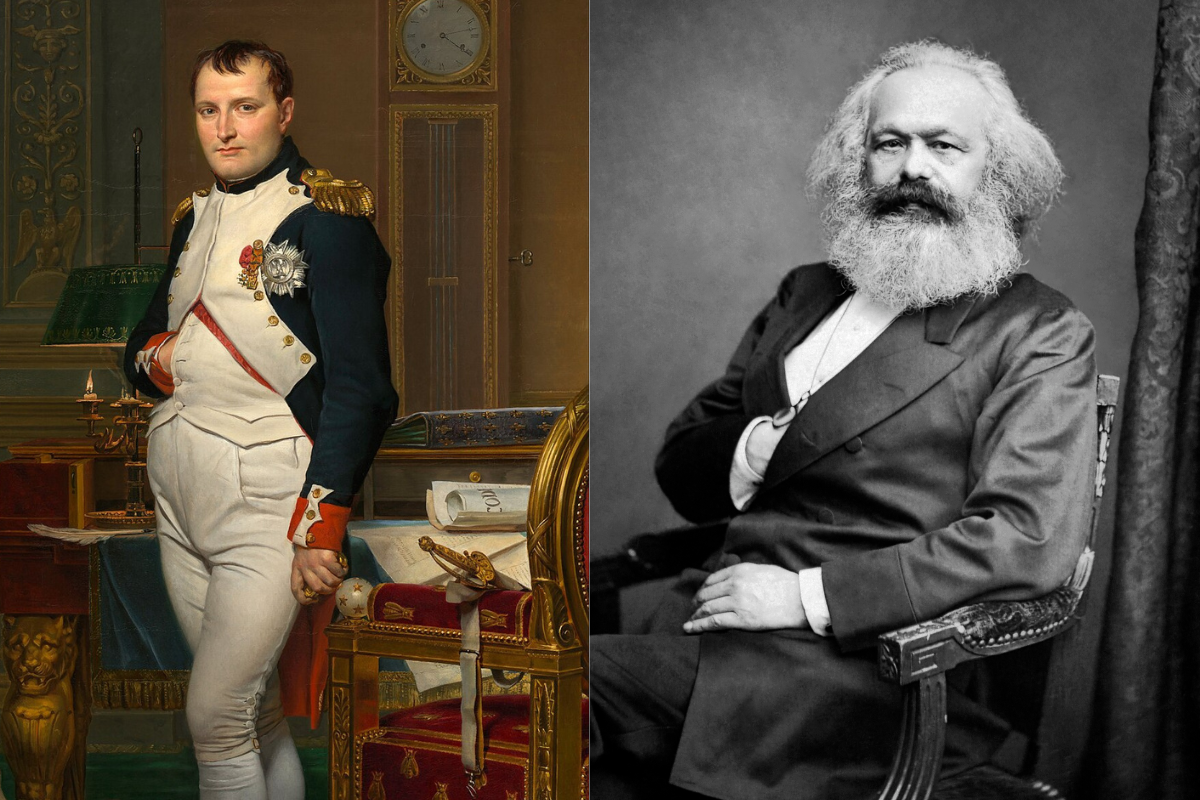 | ||
Why do men in famous portraits all have one hand in their coat? | ||
Historians explain why men in old-timey portraits always had one hand in their vest or coat | ||
It goes all the way back to the days of ancient Greece. | ||
By Evan Porter | ||
One of the most famous portraits of Napoleon, completed in 1812, features him striking a rather odd pose. He’s slouching in a formal uniform while standing in his study, but it’s the placement of his right hand that strikes some viewers as unique. | ||
His hand is tucked into his uniform. Not in a pocket, per se, but right through the buttons, which have been opened to accommodate all five fingers. It looks a little like he’s getting ready to pull out a pocket watch or a pistol. It’s not a pose you would see commonly these days, that’s for sure. | ||
|
Culture

A Harvard psychologist shares the seven tiny phrases that build lasting trust.
Relationships are complex things, but the ones that really work, according to Dr. Cortney Warren, a Harvard-trained psychologist, have something surprisingly consistent in common. In this story by Erik Barnes, she reveals the tiny verbal habits she hears in the happiest, most secure couples.
Warren says these seven phrases act like emotional shortcuts. They soften conflict, signal safety, and quietly rewrite the rules of partnership in all the best ways. Pair them with a few nonverbal cues, and suddenly the whole relationship feels sturdier.
What are the phrases? Why do they work so well? And which one might change your dynamic tonight?


On this day in 1938, Chester Carlson and his assistant, Otto Kornei, made the first xerographic copy in a small lab in Queens. The immortal words they preserved? “10-22-38 Astoria.” A little light on poetry, but the beginning of something big. Working in a patent department, Carlson had grown frustrated with the tedious business of duplicating documents. His solution used light, static electricity, and powder to reproduce text without wet photographic chemicals.
More than 20 companies passed on the invention before it found backing, and another 21 years elapsed before the Xerox 914 brought convenient, push-button copying to offices. Carlson became wealthy, then gave away $100 million to charity. A pretty good legacy for a man who just wanted another copy of the paperwork.
Do you have something GOOD to share?
We’re always on the lookout for uplifting, enlightening, and engaging content to share with readers like you. If you have something you think should be featured in the Daily GOOD, let me know!
💬 From the group text…
I love seeing an expert make music on my favorite instrument, the… stringed… toucan-looking bass guitar combo?

Join the Group Text! Send us your social media gold.
Until tomorrow, remember 🎶Maps! They don’t love you like I love you! 🎶