- The Daily GOOD
- Posts
- Our feline overlords have a long history
Our feline overlords have a long history
Plus, an otter reunion that might melt your heart.

Greg Sullivan
November 20, 2026 • Est. Reading Time: 4 minutes
In partnership with


“There are two means of refuge from the misery of life — music and cats.”
― Albert Schweitzer
In this issue, a 12th-century poet reminds us that cats have always been cats, an orphaned otter makes a rather persuasive case for friendship, and we learn why doing something badly might be just what the doctor ordered. Plus, it's Friday, which means it’s time for the latest reader-submitted pet picture.
Culture

Cat memes are nothing new.
Some things about our feline overlords never change
Cats have been stealing blankets and inspiring poetry for 800 years.
The internet may have convinced us that cat obsession is a modern phenomenon, but humans have been hopelessly devoted to these furry little freeloaders for centuries. Long before Instagram, people were already writing about their cats and forgiving them for doing absolutely nothing productive.
Take Lu You, a 12th-century Chinese poet who wrote more than 9,000 poems, including several about his cats. In one, he complains:
“You frequently get drunk from catnip,
You commandeer the blanket every night.”
Some things really never change.
As University of Virginia professor Jack W. Chen explains, Lu You saw his cats as more than household pest control. They were companions worthy of affection and even poetry. And one of his final poems offers a surprisingly moving glimpse of just how much they meant to him.


GOOD reader Susan Schustak shared this pastoral image of Horse Hill in Mill Valley, California. I love the image, but the hill's name loses points for creativity.
Do you have a GOOD picture to share?
Send us your best images, and we may feature them as the image of the day. Be sure to tell us a bit about your pic.
Ready to break up with cable news?

It started with the fear. Then the panic. Then you realized they needed you outraged more than informed.
Meet 1440’s Daily Digest: one daily newsletter covering 100+ sources, edited by hand. No algorithms. By humans. Just the facts, in a five-minute read. It's free, and 4+ million readers already start their day with it.

What does it mean when an animal is crepuscular?It's a real word, not a description of your cat's attitude. |
Yesterday’s Results
In yesterday’s issue, we explored what happens when kids have fewer restrictions around candy. Naturally, that got us thinking about the things we grown-ups have trouble resisting.
And we asked: Which forbidden fruit is hardest for you to resist? Sweets and snacks took the cake, and probably ate it too, with 54.4% of the vote.
Sweets and snacks (54.4%) 🏆
Staying up way too late (19.4%)
Buying something I don't need (20.0%)
Whatever someone tells me I can't have (6.3%)
GOOD reader Helen Seagroves struggles with impossible decisions. “Either chocolate or chocolate.”
Animals | Courtesy of Upworthy
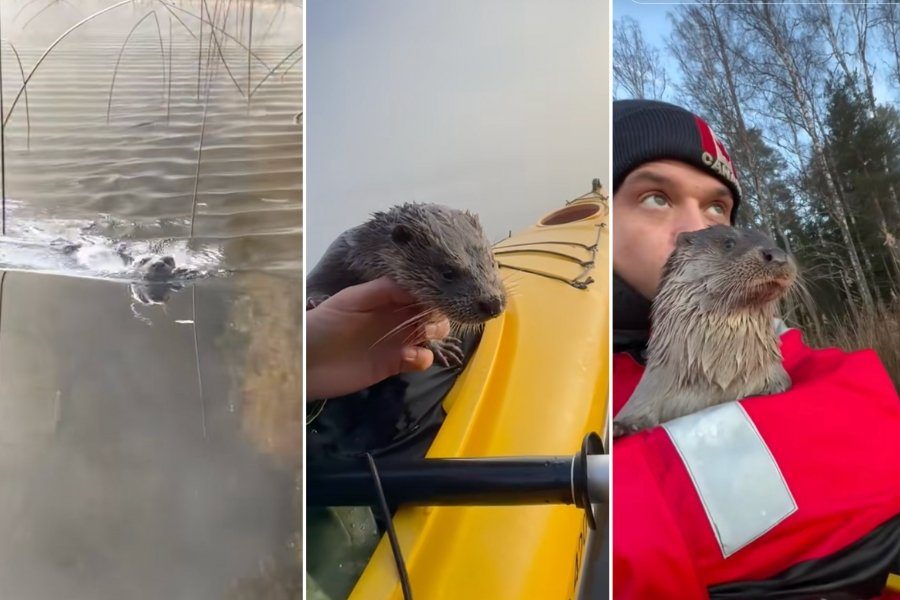 | ||
Man who raised and released an orphaned otter films her swimming to his kayak for cuddles | ||
Leya’s bond with her human rescuer is so beautiful. | ||
By Annie Reneau | ||
When Mats Janzon found Leya, she was just a tiny baby curled up alone in the grass near his home in Sweden. Janzon was out on a quiet walk in the woods when he heard a soft peeping sound and saw it was a baby otter. He kept his distance for several hours, hoping her mother would return. When no one came, he searched the area and found that her mother had been killed on a major road nearby. Leya appeared to be starving and barely breathing, and he knew she wouldn’t make it without help. | ||
Janzon had volunteered with animal rescues while working as a pilot in Cyprus, but after moving back to Sweden several years ago, he felt a pull to leave his job and spend more time in nature. “This shift led me to focus on helping wildlife,” Janzon tells Upworthy. “I’ve cared for various animals, mostly birds, that seemed to find me. Huginn, a crow I rescued, stayed with me for three years before he was ready to join his own flock in the wild.” | ||
|
Health

A University of Cambridge study landed on coping skills that sound backward.
Anxiety has a knack for coming back. You think you've finally beaten it, then it returns with reinforcements, fraying your sleep, your focus, and your ability to sit through a meeting without spiraling. Olivia Remes, a PhD candidate at the University of Cambridge, walks through the coping skills her team's research surfaced. The catch is that the most effective ones sound completely backwards.
Take the first rule: do it badly. Remes borrows a line from writer GK Chesterton, who insisted that "anything worth doing is worth doing badly." The point is that perfectionism is a stall tactic dressed up as a virtue. Waiting for the perfect moment is how the thing never gets done, and how the worry compounds while you wait. Lower the bar, start the task, and the dread starts to lose its grip.
Who’s a GOOD boy/girl?
Image of the Day has its own lane, but the pet pics keep arriving, and I am not made of stone. So every Friday, I’ll share one reader-submitted photo of a favorite pet. Want yours featured? Send it along.

Rebecca Lewis shares this picture of her big boy Scooter. She says she adopted him when he was about a month old and raised him on a bottle. Rebecca, I have to ask, how big was the bottle?!?


On November 20, 1923, African American inventor Garrett Morgan received a patent for an improved traffic signal designed to make America's increasingly crowded intersections safer. After witnessing a collision between an automobile and a horse-drawn carriage, Morgan developed a manually operated, three-position signal that added an important innovation to the existing stop-and-go system.
His design included an interval when traffic in every direction had to stop, giving intersections a chance to clear before vehicles started moving again. Morgan eventually sold the patent rights to General Electric for $40,000. Although his invention wasn't the modern three-color traffic light, it helped advance a simple but important idea: sometimes the safest way forward is to make everybody stop for a moment.
Do you have something GOOD to share?
We’re always on the lookout for uplifting, enlightening, and engaging content to share with readers like you. If you have something you think should be featured in the Daily GOOD, let me know!
💬 From the group text…
This guy has a whale of an appetite!

Join the Group Text! Send us your social media gold.
Until next week, keep in mind there’s nothing wrong with being crepuscular.