- The Daily GOOD
- Posts
- Punching back at the company spies
Punching back at the company spies
One woman did what needed doing, Martin Luther King Jr. had a GOOD idea, and 14 tools you can use to combat the stress that won't stop coming.

Greg Sullivan
January 13, 2026 • Est. Reading Time: 4 minutes
In partnership with


“May the New Year bring you courage to break your resolutions early!”
― Aleister Crowley
In this issue...
Culture

Once more, we play our dangerous game*.
As many as 86% of employers use software to monitor employees’ computer activity. That is… awesome! I’m so glad you do that! … Do you think they’re still looking? OK, I think they’re gone. One employee knew she was being monitored and had made a sort of tentative peace with the idea, but her computer was not pleased. The spyware… er… awesome productivity-enhancing performance-ware, was obliterating her computer’s performance.
“I decided enough was enough.”
Redditor Rakhered shared her high-risk plan to take back power. Well… processing power, at least. As Adam Albright Hanna reports, the fix involved some tricky hacking and a lot of guts. The community had opinions that one hopes they shared from their personal, unmonitored devices.


Stay One Scoop Ahead of the New Year

The new year is the perfect time to build healthy habits that actually stick. AG1 helps you stay one scoop ahead of the new year by supporting energy, gut health, and filling common nutrient gaps, all with a simple daily routine.
Instead of chasing resolutions that are hard to maintain, AG1 makes health easier. Just one scoop each morning supports digestive regularity, immune defense, and energy levels, making it one of the most effortless habits to keep all year long. A fresh year brings fresh momentum, and small daily habits can make a meaningful difference.
Start your mornings with AG1, the daily health drink with 75+ ingredients, including 5 probiotic strains, designed to replace a multivitamin, probiotics, and more, all in one scoop.
For a limited time only, get a FREE AG1 duffel bag and FREE AG1 Welcome Kit with your first AG1 subscription! Only while supplies last. Get started today.
Culture

Long before “universal basic income” became a startup talking point, Martin Luther King Jr. was framing it as a moral necessity.
When people talk about Martin Luther King Jr., they usually stop at civil rights and voting rights. But as Tarah Williams and Andrew Bebel explain in this story, King was also making a sweeping economic argument that still feels unfinished.
King was responding to racial discrimination and structural exclusion, but his concern ran deeper than wages alone. He worried about a society that measures human worth by economic usefulness, and what happens when large groups of people are told they are no longer needed.
“The rich must not ignore the poor, because both rich and poor are tied in a single garment of destiny.”
At the height of his activism, King pushed for a guaranteed income, not as charity, but as a recognition that dignity should not depend on luck, labor markets, or who happens to be in demand. His belief was simple and quietly radical: a society cannot call itself healthy while millions are structurally sidelined.
That idea never fully took hold. But it never disappeared either. As automation, AI, and shifting work reshape how value is assigned, King’s economic vision is starting to feel less like history and more like a question we still have not answered.

How do you feel about Universal Basic Income?A check just for existing... |
So, how are those resolutions doing?
In yesterday’s edition of the Daily GOOD, I asked how your New Year’s resolutions are doing. And… they’re not! Over 2/3s of you didn’t make a resolution in the first place. Guess you can’t break what you don’t make.
I'd broken mine before the end of the Rose Parade. (6.0%)
I didn't even bother to make one. (68.7%)
Still going strong! This'll be the one that sticks! (11.9%)
I'm hanging in there, but it's getting dodgy. (13.4%)
Health

When the world will not let up. Real people are sharing the weird little things that actually help.
Anxiety has a sneaky way of hijacking your day. Sometimes it is a low hum of dread. Sometimes it is a full-blown spiral at 3 a.m. Either way, it is exhausting.
We asked our sister site Upworthy’s Facebook page community (what’s that make us?) a question: “What do you do that completely obliterates your anxiety?” As Adam Albright Hanna reports in this story, nearly 2,000 people answered, and the responses were equal parts heartfelt, practical, and beautifully unhinged.
"I randomly scream into the void. Also, tacos."
Some people swear by nature walks, stress naps, or cuddling animals. Others clean like they are mad at their cabinets. One person listens to Pink Floyd. Another just screams into the void. Tacos also make a strong showing.
None of these are magic fixes. But together, they form a very human reminder that coping does not have to be perfect or polished. Sometimes it just has to be doable.

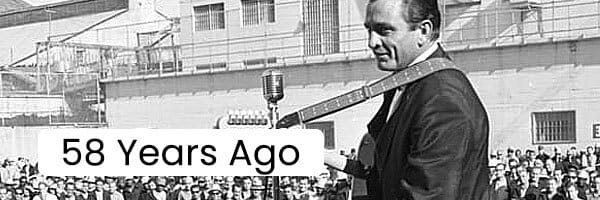
“Hello, I’m Johnny Cash…” On January 13, 1968, Johnny Cash took the stage at Folsom Prison, a performance that reinvigorated his career and helped put prison conditions on the national stage. Cash, who had been struggling with drugs, arrests, and slumping sales, had recently steadied himself with an enormous amount of help from his soon-to-be wife, June Carter, and the album would mark a major turning point in his life.
There were two concerts that day, but the magic was in the morning show; all but two tracks on the album come from that first set. Listening to the record, you can feel the room. Cash even playfully tells the men to settle down, reminding them the show is being recorded, while his emcee, Hugh Cherry, handles announcements on behalf of the prison. “These men have reception, Ned Block, 850362, and Matt Sheldon, 839879. They have reception…”
The performance at Folsom didn’t just relaunch Cash’s career; it turned a country singer into one of the era’s most visible mainstream advocates for rehabilitation, parole reform, and basic human dignity behind bars. In the years that followed, he testified before Congress and met with President Richard Nixon (July 26, 1972), keeping the topic in front of a mass audience as slow-moving reforms took hold.
Do you have something GOOD to share?
We’re always on the lookout for uplifting, enlightening, and engaging content to share with readers like you. If you have something you think should be featured in the Daily GOOD, let me know!
💬 From the group text…
David Bowie got the internet almost exactly right all the way back in the 1990s! I wonder what he thinks of AI?

Join the Group Text! Send us your social media gold.
Until tomorrow, may the tools in your mental health toolbox be up to the challenge of your day.