- The Daily GOOD
- Posts
- Some doctors are prescribing dogs now
Some doctors are prescribing dogs now
Doctors are writing pets into real treatment plans, a bad mood expires in 90 seconds, and you have probably driven through the happiest city in America.

Greg Sullivan
August 21, 2026 • Est. Reading Time: 5 minutes
In partnership with


“No amount of regretting can change the past, and no amount of worrying can change the future.”
― Roy T. Bennett
In this issue of The Daily Good, I learned my dog Gabby may qualify as medical equipment. We get into the 90-second rule for surviving a bad mood and the modest American city that ranks as the happiest in the country. There is also a polar bear deep in thought and a Friday pet photo involving some serious bed theft.
Well-being

The pharmacy might have to become more fun.
Ask a room of pet owners why they got the dog, and you will hear the usual answers. The kids begged. The shelter photo did it. I’ve always had dogs. But a Human Animal Bond Research Institute* survey found that 1 in 5 pet owners say a doctor or therapist recommended it. Somewhere between the vet bills and chewed baseboards, pets quietly became part of a real treatment plan.
The mechanism is not sentimental. It is chemical. In this story by Christine Abdelmalek, the numbers get specific: roughly 10 minutes of petting a dog, ideally with eye contact, is enough to boost oxytocin and lower cortisol. The dog's oxytocin rises too, which is either very moving or proof that you are both being worked by 30,000 years of evolution. Then there is the walk, which does more than pad your daily step count. It gets you outside, on a schedule, near other people who also have to be outside on a schedule.
* - That’s a real place?!? I want to visit ASAP.


GOOD reader Mary Ann Demczak caught this introspective gent on a trip to the Pittsburgh Zoo and Aquarium with her grandson. To dive in or not to dive in, I believe that is the question that resident polar bear Snowflake is asking.
Do you have a GOOD picture to share?
Send us your best images, and we may feature them as the image of the day. Be sure to tell us a bit about your pic.
Finally, a stand mixer that can stand up to dough

Ever tried to make dough in your regular mixer?
The results aren’t pretty: Clumpy texture. Stodgy bread. Overheated motors.
So, we took the same dough-making technology that professional bakers have used for decades and packed it into a countertop machine.
Introducing Ooni Halo Core Spiral Mixer.
Its secret? Two high torque DC motors. These keep the mixer sturdy and stable even at top speed, while unlocking a powerful dual-kneading action — for softer loaves and a higher rise when it’s time to bake.
But don’t just take our word for it.

What does your pet do for your health?One in five of you were told to get one. |
And what did we learn?
So, GOOD readers, how do you drive when nobody's watching? Almost half of you are run-of-the-mill good drivers, except when that stoplight looms ahead.
Feather-light on the pedal, quietly smug about my mileage (36.6%)
Normal human with the occasional stoplight sprint (48.0%)
Every on-ramp is a runway, and I am cleared for takeoff (13.8%)
My car is a mystery to me, and we prefer it that way (1.6%)
Science | Courtesy of Upworthy
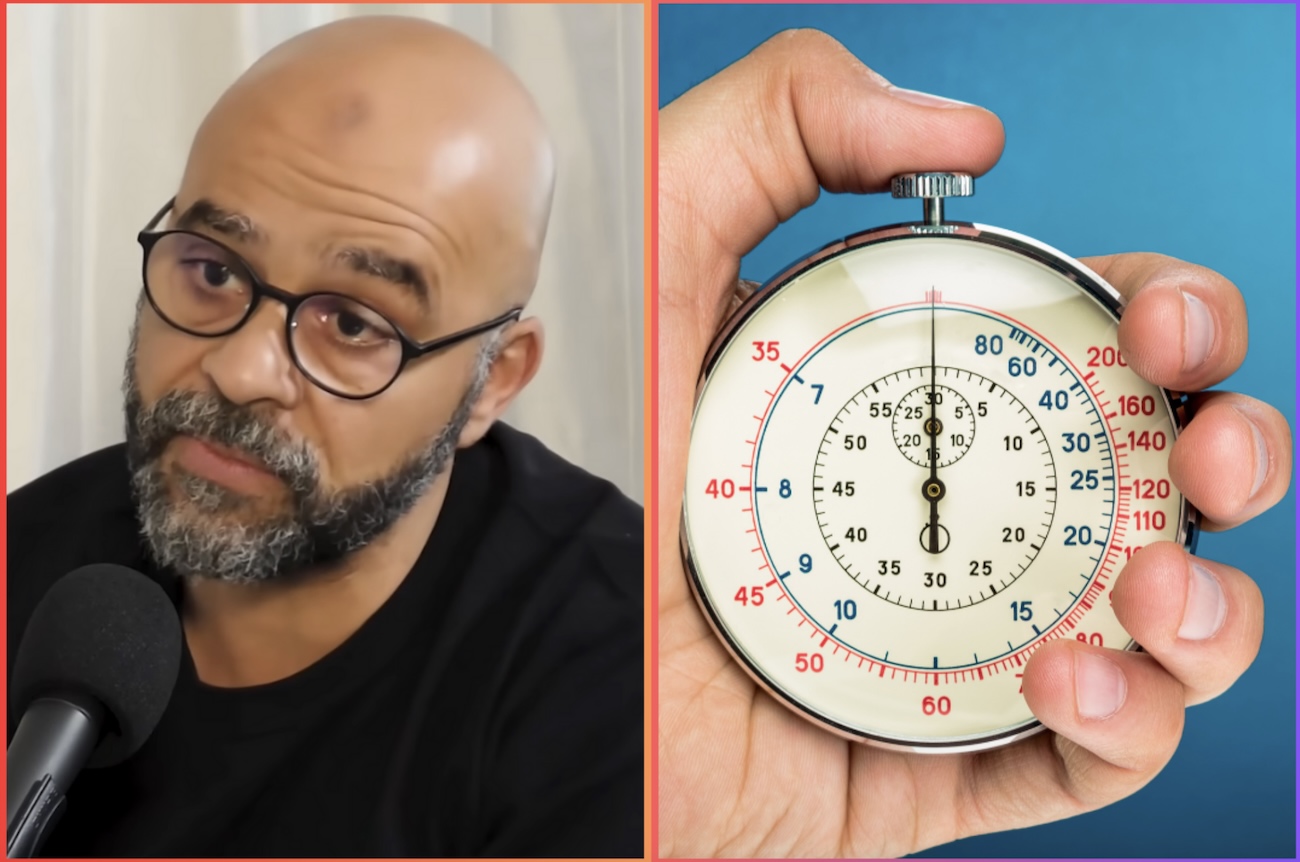 | ||
The 90-second emotional reset that’s changing lives and is backed by Harvard science | ||
Entrepreneur and author Mo Gawdat has spent over 20 years researching the science of happiness. | ||
By Kat Hong | ||
We’ve all been there: it’s 90 degrees outside, absolutely sweltering, and you’re walking home from a new smoothie shop less than a mile away from your apartment, and everything is melting. The smoothie in your right hand. The açaí bowl in your left. Your old, broken headphones slowly slip off your head as a song you’ve never heard before blares through the speakers. Your willpower is diminishing by the second, and no one is around to help you. | ||
Okay, that might be a bit specific (and precisely what happened to me about an hour ago). Still, you’ve likely had a similar experience: an encounter that left you annoyed, frustrated, or feeling hopeless. | ||
But what if I told you that, according to Mo Gawdat, a former Google executive who has spent the last 20 years researching the mechanics of happiness, you only need to endure that emotional roller coaster for precisely 90 seconds? | ||
|
Everyday Economics

Happiness is famously hard to measure, which has never stopped anyone from trying.
SmartAsset just ranked 85 of the largest U.S. cities across 11 separate factors, using Census and county health data to score each one on personal finance, well-being, and quality of life. Some of the metrics are the ones you'd expect: poverty rate, life expectancy, health insurance coverage, and whether a local salary leaves anything left over for a life after the bills.
Others are gloriously specific. There's a traffic volume measure where Austin comes out cleanest and Boston carries more than 40 times the congestion. There's the share of days residents describe as mentally healthy, where Honolulu leads at 85.2% and Toledo, Ohio, finishes last. There's even a household overcrowding count, tallying homes with more people than bedrooms, which is a quiet way of asking what rent has done to your options. It's also how Pittsburgh, a city nobody accuses of luxury, ends up with the most elbow room in America.
As Jaclyn DeJohn reports, the full top 25 goes deep enough that you'll find your own city, check its numbers, and immediately start arguing with them.
Who’s a GOOD boy/girl?
Image of the Day has its own lane, but the pet pics keep arriving, and I am not made of stone. So every Friday, I’ll share one reader-submitted photo of a favorite pet. Want yours featured? Send it along.

GOOD reader Rebecca Wilson sent me this image, titled ‘Happiness.’ She introduces our sleepy models like so. “The bulldog is Buddy. The grey tabby on the dog's bed is Ida, and the orange tabby is Huey. I get a chuckle when the cats take the dog's bed because they have beds of their own.”


On August 21, 1911, a former Louvre worker named Vincenzo Peruggia put on a white work smock, walked into the closed museum, lifted Leonardo da Vinci's Mona Lisa off the wall of the Salon Carré, pried it out of its frame in a nearby stairwell, and strolled into the Paris morning with the panel concealed under his clothes. Nobody realized it was gone until the next day, when a painter set up his easel in front of the empty spot. Staff had assumed the portrait was off being photographed.
Here is the part that usually gets skipped. In 1911, the Mona Lisa was admired by the art world but was nowhere near the household name it is today. The theft helped change that almost overnight. It ran on front pages around the world, police questioned suspects including a young Pablo Picasso, and Parisians flocked to the Louvre to gawk at the bare wall where she used to hang, drawing crowds the painting itself had never managed.
Peruggia kept her hidden in a trunk in his apartment for more than two years, then tried to hand her over to a Florence art dealer, insisting he was repatriating her to Italy. He was eventually sentenced to a little over a year in prison, a term later reduced to about seven months. She went back to the Louvre a global celebrity, made far more famous by the man who stole her.
Do you have something GOOD to share?
We’re always on the lookout for uplifting, enlightening, and engaging content to share with readers like you. If you have something you think should be featured in the Daily GOOD, let me know!
💬 From the group text…
I would love to do this so much! But I work from home and my wife probably wouldn’t appreciate me firing up something this noisy in our hallway.

Join the Group Text! Send us your social media gold.
Until next week, pet a dog and wait 90 seconds.