- The Daily GOOD
- Posts
- The middle chapter of evolution's meanest story
The middle chapter of evolution's meanest story
What happened on the road from T-rex to dino-nuggy? Would you inject robots into your body to prevent one of life's great agonies? What happens when business and ethics take it to the street?

Greg Sullivan
February 12, 2026 • Est. Reading Time: 4 minutes
In partnership with


“Educating the mind without educating the heart is no education at all.”
― Aristotle
In this issue...
Science

One of evolution’s cruelest and funniest arcs? Dinosaur to dinosaur-shaped chicken nugget.
In this story by Erik Barnes, paleontologists in Spain reveal a newly identified species called Foskeia pelendonum, a fully grown dinosaur about the size of a modern chicken. Researchers originally thought the fossils belonged to a baby. They were wrong.
After high-resolution scans, scientists discovered a skull unlike anything expected for its branch of the family tree. As Dr. Penélope Cruzado-Caballero explains, its anatomy is strange in exactly the way that reshuffles evolutionary history.
The twist: these fossils may push back this dinosaur lineage by 70 million years, filling a significant gap in the record.
So yes. Dinosaurs became birds. Birds became chickens. Chickens became dinosaur-shaped nuggets. But somewhere in that long, ridiculous arc, there was this tiny, weird-skulled creature quietly rewriting the script.


It looks like the sky is on fire in GOOD reader Gail Gililland’s photo of this striking sunset from Sherman, Texas. I don’t know about the weather in Texas, but if it’s anything like things here in Cali, the night that followed must have been amazing.
Do you have a GOOD picture to share?
Send us your best images, and we may feature them as the image of the day. Be sure to tell us a bit about your pic.
Unbiased News Trusted by 2.3 Million Americans!

The Flyover offers a refreshing alternative to traditional news.
Tired of biased headlines and endless scrolling? We deliver quick, fact-focused coverage across politics, business, sports, tech, science, and more—cutting through the noise of mainstream media.
Our experienced editorial team finds the most important stories of the day from hundreds of sources, so you don’t have to.
Join over 2.3 million readers who trust The Flyover to start their day informed, confident, and ahead of the curve.

How are you enjoying the Olympics?Competition is heating up the winter nights in Milan. |
And what did we learn?
What is it about work that irritates GOOD readers? We almost had a tie, but the surprise answer that won out? GOOD readers like their jobs!
That blasted IM ping. Stop texting me, I'm trying to work! (14.5%)
The meetings. The insufferable meetings! (20.0%)
My coworkers. Hell is other people, and these people... oof. (12.7%)
My boss. How they got their job is beyond me. (25.5%)
Is it strange that I just, sort of... like my job? (27.3%)
Health

When the enemy is kidney stones, nothing is off the table.
Normally, you might have qualms about agreeing to let doctors put micro-bots into your body and steer them southward with magnets. When the problem they’re trying to solve is the wouldn’t-wish-it-on-your-worst-enemy agony of kidney stones, you might cut them off before they could finish explaining the procedure and just yell, “Yes, sure, whatever, just do it!”
If you did let them finish, the Canadian team that invented the procedure would explain that these microbots are soft, flexible, and barely the size of a grain of rice. They would hint that magnets guide them with surprising precision. And they would probably smile a little too confidently when they describe what happens once the bots reach their target.
As Mark Wale reports, early tests suggest this might work a lot faster than anything we have now. The part they are still perfecting is how to control these things in real time and make sure they do only the very specific job they were built for.
And the part they are not saying out loud yet is the one you are probably already thinking.
If this approach holds up, kidney stone treatment could get a whole lot less medieval.
Culture

Real neighborhood upheaval is a crash course in moral decision-making.
Tim Swift is a management professor who has spent a decade volunteering at St. Francis Inn, a Kensington soup kitchen that sees the neighborhood’s hardest truths up close. A few years ago, he noticed something strange. The meal lines were shrinking, the block was changing, and the volunteers’ worried questions started sounding less like small talk and more like strategic decisions about mission, resources, and who gets served when a community transforms around you.
In this deep dive by Swift, that moment becomes the spark for a case study he now teaches to senior business students. They step into the same tension he felt on the ground, weighing a beloved nonprofit’s core strengths against the needs of unhoused neighbors, longtime residents, new arrivals, and the people pushing for Kensington to look different.
The result is a lesson that refuses to stay tidy. Students face choices where every option helps someone and harms someone else, where ethics and strategy depend on each other, and where the right move is never obvious. And that is exactly why Swift brought the story into the classroom.

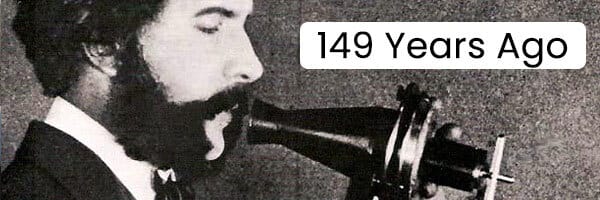
On February 12, 1877, at Lyceum Hall in Salem, Massachusetts, about 500 people squeezed in while Alexander Graham Bell stood on stage, ready to demonstrate a world-altering piece of technology, the first ever “long-distance” phone call. The plan: send a human voice, not just clicks and beeps, along a wire to Boston, about 14 miles away.
A reporter named H. M. Batchelder took to the stage in Salem. At the other end of the line sat A. B. Fletcher of the Boston Globe. They started talking, and the crowd in Salem could actually make out the words. The voices were recognizable. Even the applause in the hall carried over the line. In a world still getting used to the telegraph, first demonstrated in 1844, remote voice was a revelation.
Within weeks, people wanted in. Early phone service was point-to-point, one private wire at a time. A Boston banker named Roswell C. Downer was among the first to sign up, running about 3 miles of line between his home and his office. Service cost $1.50 a month, roughly $49 today, and early adopters were mostly businesses. The early version of the phone didn’t ring; calls would either begin at scheduled times, or people would simply shout into one end, hoping someone on the other was near and listening.
It was later that year that someone thought to invent the ringer. We imagine that shortly thereafter, the first cry of “don’t answer that, I’m not here!” was heard.
Do you have something GOOD to share?
We’re always on the lookout for uplifting, enlightening, and engaging content to share with readers like you. If you have something you think should be featured in the Daily GOOD, let me know!
💬 From the group text…
Mars is a baby hippo that doesn’t want to get out of “bed” and looks like a giant, cute baked potato. Why haven’t you clicked yet?

Join the Group Text! Send us your social media gold.
Until tomorrow, may you enjoy your nuggets with deep reverence for their mighty ancestral heritage.